


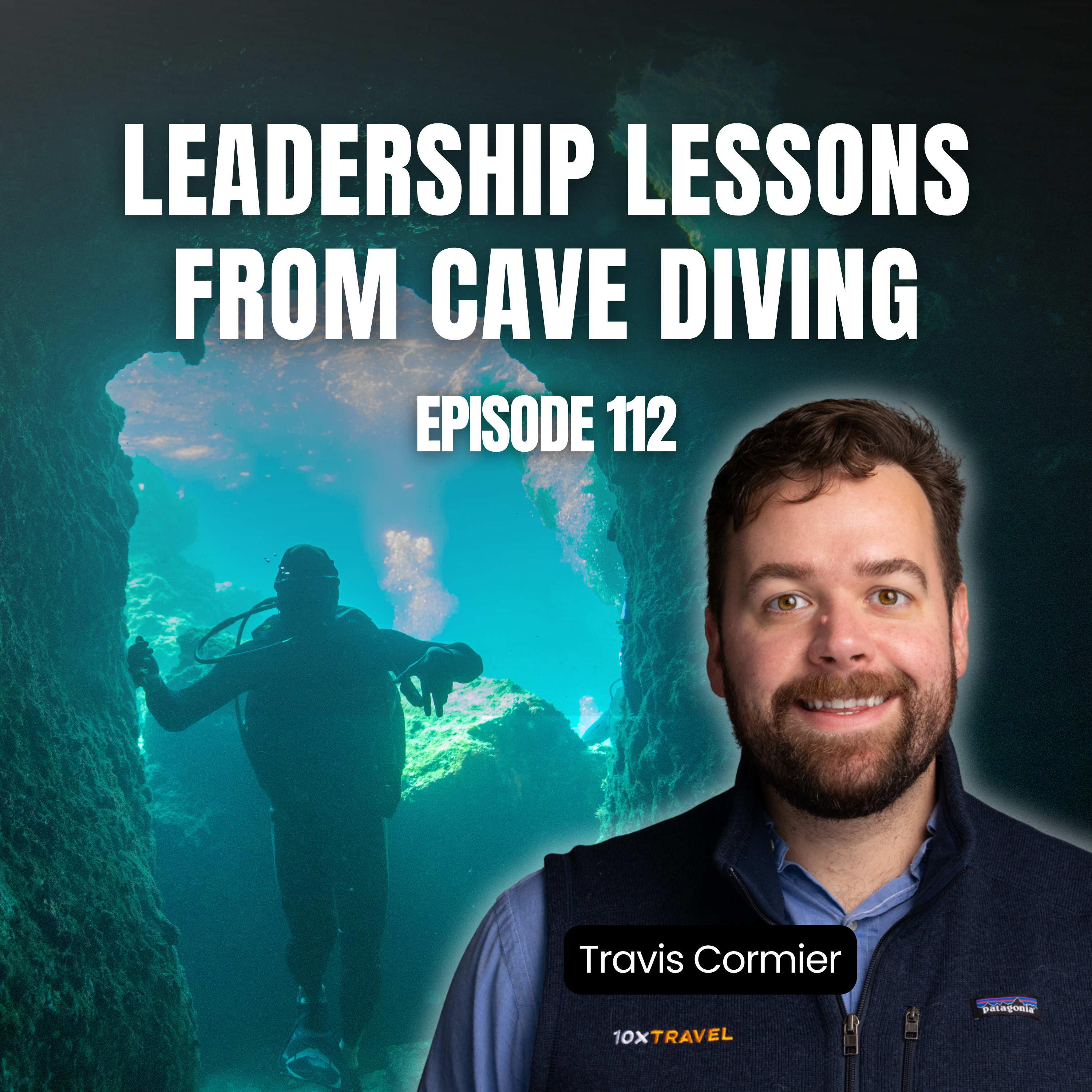


In this episode, Travis Cormier shares powerful leadership lessons from cave diving on building a team culture that fosters independence.
Travis Cormier, CEO of The 10X Travel Company, which helps consumers leverage their spending to get better travel experiences. 10X Travel has been around since 2014 and has built a community of 400,000+ people.
Travis shares leadership lessons from cave diving, frameworks, and his personal experience. We talk about how to view problems in a way that helps build a team culture that results in independence. When managers achieve this result, they get back the most precious resource: time!
If you are a new manager who values your time, Travis Cormier's insights will deliver results.
Follow Travis Cormier & The 10xTravel Team
Website | Facebook | Instagram | LinkedIn | YouTube | TikTok
Takeaways
- Management skills differ from individual contributor skills.
- Failure is a learning opportunity, not a setback.
- Building a supportive team environment is essential.
- Time management requires creating reserves for emergencies.
- Documentation is crucial for knowledge transfer.
- Training should align with future challenges.
- Micromanagement can be a tool for development.
- Trust your team to handle their responsibilities.
- Cave diving principles can apply to management.
- Continuous learning is vital for leadership growth.
Sound Bites
"Be trained for the dive that you’re doing."
"Micromanagement can be a development skill."
"You have to get out of the way."
Chapters
00:00 Introduction to Travis Cormier and 10X Travel
03:00 Travis's Journey to Leadership
05:31 The Importance of Management Skills
07:58 Lessons from Cave Diving
10:33 Framework for Effective Management
12:57 Reframing Failure in Leadership
15:39 Building a Supportive Team Environment
18:05 The Rule of Thirds in Time Management
20:53 Creating Redundancy in Team Skills
23:15 The Importance of Documentation
25:50 Training for Future Challenges
28:27 Final Thoughts and Future Goals
Paul Leon (00:00)
I have with us today Travis Cormier. He's the CEO of 10X Travel, a seven figure digital education company that helps entrepreneurs and professionals maximize rewards from everyday business spending, which is about turning routine expenses into strategic leverage, travel and operational flexibility.
Over eight years, Travis has grown from a freelance writer to a CEO leading teams, scaling operations and building systems that balance growth with culture and execution. Travis's expertise in leadership development, operational strategy and designing processes that empower teams, reduce bottlenecks and enable businesses to scale efficiently. His practical insights help manage transitions to foster accountability.
create systems that support business success and employee engagement. His hands on operator level perspective aligns perfectly with our conversation today.
Travis, what I was really excited about today is we're to go through some frameworks or go through some of your journey. And really what I want to peel the onion around is really how you've had this level of success. How you've taken on being a CEO and really highlight that because I think the biggest tax in business and
is that ignorance tax. And what I love about you and your solutions is that you've really found those riches in that niches of just the pain of people traveling and creating those systems. And your team is phenomenal. You guys do a lot of not just education, but it's edutainment where you guys are not only educating people, but you're making it an entertaining way.
Let's talk about the framework we have on the table today and go where you feel is best for your expertise and let's start there if that's a good launching point for you Travis.
Travis Cormier (01:57)
Yeah, that sounds great. I'll share a bit of my background. Like a lot of people out there, this was not the career trajectory or where I thought my career was going to end up. I I just stumbled into management and leadership by accident. And I think that that's what happens to a lot of people. They're a good performing individual contributor. Management feels like the next step.
And they end up there, but they don't realize ahead of time that the skill sets that you need to be a good manager or a good leader are completely different from what you need to be a good individual contributor. It's no longer about the work that you produce, but it's the outcomes that you can derive from your team.
Going in by accident, blindly means you don't have the tools and the frameworks to know how to handle that. And that's what happened to me. I just came across opportunities. I was a freelance writer, our editor left. at the time I was our longest 10 year writer. So I just asked and ended up there.
I used to be a chemist by trade, so not even from a writing background. it's been a crazy career journey. And eventually the founder of our company decided to go all in. He quit his job. He called me and said, you want to come be my number two? Same thing. I'd never been a COO before, but figured why not? after about four years,
Paul Leon (03:15)
wow.
Travis Cormier (03:33)
Our founder, Bryce, decided that the business was just moving into a new phase. had the humility to realize that he wasn't the right person to lead it through that next phase and felt that I was. And that's how I've ended up as CEO. ⁓
Paul Leon (03:49)
Hmm.
Travis Cormier (03:49)
And along that path, especially being a small growing company, know, being employee number two, now we've got, we're still a small business. We've got about 15 full-time employees and about 20 contractors. But it means having to grow and develop those skills along with the business. with no formal training, was
kind of figuring it out a lot as I went. plenty of books behind me to read. There's lots of information, but if you're like me, when you're reading a book about management or leadership, out of the two or 300 pages, you might only have one thing that you remember that stands out to you. It's hard to ingest and apply all of that information and...
I don't like to reread books. It just feels redundant to me. I'd rather read something else. So I tried to look and say, where else in my life do I have skills and experience that can cross over into management and leadership? And I think that's an opportunity that a lot of people really miss. They are so focused on the job and trying to learn new skills. They don't.
stop and ask themselves, what skills do I already have that might not on paper be leadership skills or management skills, but that I can apply that I'm already used to doing. And that really helped me and has helped a lot of people kind of break through that period of ignorance because it gives you something you already have experience in that you, can't apply.
for me, I turned to my hobbies. do the hobby that no one's mom wants them to do. I'm a cave diver. So I was been scuba diving for a long time and told myself I would never do cave diving accidentally ended up falling down that rabbit hole and just loving it. but the parallels to business,
Paul Leon (05:43)
Hmm,
Travis Cormier (05:46)
stood out to me like cave diving. It's a high stakes environment. There's a lot on your plate. and you have to remain calm and focused to remain safe. one day it just clicked that there's a lot of the rules that we follow that can apply to, management and, and
I'm sure most people out there aren't cave divers, but my hope is that some of them can take away that, their lived experience up to this point can still apply to, to management and lean on that. That's your strength while you're building up those, those, those extra skills.
Paul Leon (06:25)
Talk to me about when you first started getting into the world of let's just say people management. What would you say are some of those things, maybe one or three things that you were like, if you could go back in time and talk to younger self, we'll frame it this way, but you couldn't tell your younger self it's you from the future and you couldn't tell your younger self you're from the future. what would you need to tell
yourself to be like hey this is what you need to change to be better at management and how would you say it connecting to maybe what you do now which is cave diving maybe that we can go there and kind of would that give you a good launching off platform if we frame that way Travis
Travis Cormier (07:09)
Yeah, absolutely.
if there was one thing that I would tell myself, it's when you move into management and leadership, you're not there to do the work for your team. And that's a really uncomfortable
feeling for a lot of people at first, it takes a while to wrap your mind around them. But the number one responsibility that you have is to develop your people, to grow them, to get the results out of them. it takes time to make that mental shift and to get out of their way.
oftentimes say, no, I'm not doing that for you. And just finding frameworks to know when you need to get involved, how to get involved, that can accomplish getting the work done while developing them. And that was something I certainly struggled with. I'm a helper. I like to help people. And so when someone would come to me with a problem,
my instinct was to jump right in get in the trenches along alongside them. And what I realized is I'm disempowering them. I'm taking on their responsibility for them. And I already have this my own bucket of responsibility. when that starts to overflow, that's when those feelings of being burnt out, overwhelmed.
that many new managers and leaders go through naturally happens. And so I drew these parallels between the five basic rules of cave diving and management to help me manage these. Pioneering cave diver Shrek actually, and I think it was the late 70s.
Notice a lot of people were dying. That's what you always hear when people talk about cave diving is how like it's the deadliest sport on on earth. And he said, can we stop people from dying or can we at least like reduce the risk of that happening? And so he he studied accidents and came up with five rules.
Paul Leon (08:54)
Okay.
Yeah
Travis Cormier (09:07)
wrote this book called The Blueprint for Survival, which are the five rules to keep you alive underwater. surprisingly, those same five rules, with some creative interpretation, can apply to new managers to help.
to help you stay afloat and stay alive as a manager as well.
the first one and one of the golden rules when we're when we're inside of a cave is to always have a continuous guideline to the surface. There are these these nylon ropes. They're not like big ropes, but these nylon lines underwater. So that way, if things happen right, there's dust and dirt under.
Paul Leon (09:33)
⁓ I like that.
Travis Cormier (09:45)
under there and if it stirs up and blinds you, you've got your rope that you can follow to get out.
It's your lifeline back to the surface. And how can you have a lifeline back to the surface in business? What framework can you build when you start feeling overwhelmed and not necessarily knowing how to manage and lead people I stumbled upon the Eisenhower matrix. This is kind of my...
my guideline to help me maintain the focus on the work that I need to be doing. If people aren't familiar with the Eisenhower matrix, it's really simple. When something comes up, you ask yourself, how important is this? And how urgent is this? So as a manager, when someone comes to me with a problem, if it is not both important and urgent, I do not need to be the one to address it.
If it is important, but not urgent, that means it can wait. And we have a weekly tactical meeting where we can discuss these, solve these as a team. We already have the space for that. So my time is protected. So you can focus on your important work that needs to get done by creating that, that dedicated time and space. It allows you to know we're going to address this important thing, but we don't have to address it right now.
If something is urgent, but not important. This is actually one of the trickiest ones that happens because your direct report comes to you with something. It's urgent to them. They want to get it fixed and they feel the pressure to get it done. And if you're like me and like most people, you want to be helpful. You feel that your job is to help them. But again, that is not your job. Your job is to develop them and grow them and get results from.
And the Eisenhower matrix, this is one spot where I deviate from it a bit. It says if something is urgent, but not important, you can just delegate it away. And I don't inherently disagree with that, but I actually think for new leaders, it can be more empowering to view it as something that is urgent, but not important. Means that it's a low stakes risk.
So this is less about like the tactical, do you do it and more what's the mindset shift that can empower you and make it easier to do this whenever that's not your natural instinct. when it's this low stakes risk, this is the opportunity to potentially let someone fail. Because if they fail, it's not important. It's just something urgent. And
we can be so protective of our people and not wanting them to fail that we step in to solve it for them. And that means they're not getting those reps. They're not getting those opportunities for development to put out fires themselves, to start critically thinking about problems, Not just following the SOP. Now you've got a problem that needs to be solved fast. And how do I solve it?
Paul Leon (12:38)
All
Travis Cormier (12:39)
And my thinking of it that way by it's your your intentionally allowing them to build that muscle, even if they fail, it's the low risk, so they'll get better at it over time. And so that's kind of like the guideline that I use to maintain that focus and determine what is the purpose of my involvement on these issues that have been been brought to me. So it makes it much easier and clearer to to stay.
stay out of the way, stay out of the day-to-day chaos, and only focus on the things that are urgent and important.
Paul Leon (13:13)
I'm curious, Travis, would you help me understand how do you reframe failure maybe for yourself or if somebody is struggling with it? And I don't believe, I don't know, maybe you've had this experience or I don't believe people just come to you and say, I've failed or I'm a failure. Like nobody admits they're stupid, And like the common sense, I would never call anybody stupid, like in general.
But how do you personally reframe failure or help someone in that type of situation? Because I think that's a big miss, at least for many, professionals, and at least myself. I'm guilty of not reframing it fast enough. And then we'll keep going with the steps in the Eisenhower model, if that's fair.
Travis Cormier (13:59)
Yeah, that's fair. That's a really good question.
when we talk about failure, that word inherently has a negative connotation to it. We hear failure and think bad. Failure is only bad if you don't learn anything from it.
the, the value that comes from failure is the learning opportunity that, that you come from it. And by using that urgent and important and letting people have the opportunity to fail on things that aren't important, it means that they can learn now while the risks are lower. And that takes a lot of that pressure off. The stakes are low. Let them try to figure it out and.
And it, it lets people get comfortable with failure. Like failure is just a part of business, and you just kind of have to succeed on more things than, than you fail on. But if you're never failing, then you're not learning and you're probably not pushing yourself hard enough anyways. So viewing it as a tool and a mindset of failure is development rather than.
failure is bad and don't get me wrong, there are definitely times when failure is a bad thing, but it's rejecting the idea that failure is always a bad thing. There are times when failure can be a good thing. if I can give an example that probably resonates with a lot of people, take paid advertising. When you start doing paid advertising, you're going to do a couple of different
Hopefully you're going to do a couple of different campaigns. Some are going to succeed, some are going to fail.
Well, what we learned is what doesn't work. So you create the space to fail. you know, well, I'm just not going to waste money on, you know, maybe Facebook ads don't work for your business, but Google ads do. Great. Like I failed, we failed at Facebook ads, but we found something that works. we're just going to now put that time and energy into what we learned works. And we know Facebook ads failed. Why did they fail?
Paul Leon (15:38)
you
Travis Cormier (16:01)
Right. You can get into some root cause analysis, dig into it, try to identify the reason it actually failed. If you want, like you can get deeper and get more insights to that way later. If you decide to retry it, you've got these lessons learned, learned already. But that reframing I think is really, really important and allowing it to happen in those low stakes environments.
Paul Leon (16:23)
what is this second part framework? And I do like this Eisenhower Framework. I personally have not been familiar with it personally, which is why I'm kind of excited to reverse engineer. But what's the second part of the framework, if I may ask?
Travis Cormier (16:36)
the second part is what in cave diving we call the rule of thirds. ⁓ The rule of thirds. this is actually one of my favorite questions to kind of ask people is.
Paul Leon (16:41)
rule of thirds. Okay.
Travis Cormier (16:47)
If you ask someone, okay, you're going in, how do you know when to come back? A lot of times people's instinct is tell me, once you've used half, so you've got half to get out. That's cool. that's, that's your natural instinct. But now what happens if you come out slower than you went in or something happens, you don't have any reserve there. So the rule of thirds is we, we reserve a third for going in a third for coming out. And that extra third is our emergency buffer.
too often in management and business, we try to operate at 100 % capacity and never leave ourselves that reserve for those emergencies. And that's when your time can feel so consumed, like you don't have time for everything. It's because you haven't built that time, it can be really simple to do.
time block my calendar every week. Friday, I sit down and look at the next week and block out what I'm going to do.
That's where a lot of people start with time blocking. Then things happen. And that's why I think time blocking, a lot of people feel like it doesn't work because other things come up that, you you apply the Eisenhower matrix. Now I do need to get involved. I didn't save time for this. What am I going to do with my other work? I fall behind. Now I'm panicking. I'm going home. I'm working at nights, working at weekends, not spending time with my, with my family. And it's because you didn't keep that emergency reserve.
Paul Leon (17:45)
You
Plug (18:10)
Paul Leon here. I want to take my hat off for a moment and speak directly to you, the listener or watcher of our show here at the managers Mic thank you so much for being consumer of the show and I want to take our relationship a step further. When you join our newsletter at the managers Mic.com website I'm going to give you a free resource called a selling script to sky rocket sales.
Thank you so much for being a listener and watcher of the show. And now back to the episode.
Travis Cormier (18:39)
So a small tactical way that I do this, that I encourage all of the managers on my team to do, is when I block my time, I block two hours twice a week just for firefighting. Typically Tuesdays and Thursdays. That means I've already got that reserve time set aside for the stuff that comes up. And if nothing comes up, great. I can find other things to do. But if it does, I've already allocated that time.
And if it comes up on Monday and has to be done on Monday, I can just swap things in my calendar, move that time to Monday. Now I know, well, you know, I needed to draft social media posts. Well, that can wait till Tuesday. So I'll just swap these two. Now by building in those emergency reserves and that extra time, you're creating the breathing room to operate through the fires that come up.
Paul Leon (19:33)
I like that. I'm curious, have you ever had a time Travis, where somebody tried to pull you away from your calendar, where you needed to push back and there was a way that you handled it well? Because I think sometimes for me, I struggle with the word no, because I'm a people pleaser, like if I'm being real with you. I still struggle to this day to be like,
Travis Cormier (19:51)
Yeah. Yeah.
Paul Leon (19:55)
No, I don't want to talk. I can't say a lot of ways like no. I have to say it a nice way. Curious if you have any like tactics or ways that you personally respond when somebody may need to pull your time, but it's really not an emergency and you got a deadline on a project. What are some responses that you've seen work for you that create that synergy and rapport with your team, if I may?
Travis Cormier (20:17)
And I can sympathize with that. I'm a, I'm a people pleaser. I want to help people. like you said, that means that it's harder to, to do that.
I'm not gonna pretend like it gets easier if that's your nature. Like it's still hard for me to do. I still feel bad about it.
Paul Leon (20:30)
you
Yeah.
Travis Cormier (20:35)
we have a weekly tactical meeting and going back to that urgent versus important, if something's not urgent and important, This is where the, this is important, but not urgent can fall. Cause that's usually the hardest one to say no to. Cause it's like, man, no, this is important. But lean into the fact that it's not urgent. That means it doesn't have to be solved right now.
We already have a weekly meeting where we have a list of issues that need to be discussed and resolved. Put it on that list so you know, and tell people to do that, Tell them, hey, like build that muscle in them so they come to you less and they are self-filtering before it ever reaches you. So you as the natural people pleaser aren't having to say, no, put it on the agenda for our meeting. It's building that habit for them to do it.
for them to self-evaluate, hey, this is important, but it's not urgent. I know it's Tuesday, but it can wait until next Monday when we have our meeting. And we already have that time set aside to discuss this and solve those problems. these frameworks help clear that mental load. And again, like building that time, just like I have the reserve time for firefighting in a same sense, like that is the reserve time that I've dedicated
to working with my team on those items that are important but not urgent. The firefighting is for the items that are urgent and important. And then those that are urgent but not important, and everyone can feel free to listen to that again, because that's a lot of the same words over and over, but those ones that urgent and not important can just say, hey, go figure this out on your own. And it helps build this.
Paul Leon (22:07)
That's okay
Travis Cormier (22:17)
this structure that you can use to.
to at least make it easier, Like having the framework gives you the tools to do things like say no, that like both of us is not our natural inclination.
Paul Leon (22:31)
Yeah, I do struggle with that. So let's go into the middle part of the cave, which is the third point in your framework, I may, Travis, as far as the cave diving, the five rules of K-diving. What's the third rule that you leverage to ensure that you have your team stronger, if I may?
Travis Cormier (22:51)
the third rule, don't exceed your depth. So one of the things that Sheck actually found that was contributing to deaths was being in a cave and going deep. When you're scuba diving, the deeper you go, the faster you go through your air, the more risk that comes up. And he found that pushing those depth limits while inside of a cave
significantly increased fatalities. in business, like that depth is that complexity and the depth of your skills that you need to run the business or manage your team.
It's about being aware of where you are now and where you need to be in three months, six months, a year from now, because you can go deeper, but it's an incremental step. It's processes. It's building the skills to handle.
the changing environment that you're in, whether it's in the cave or in business. And find that time to ask yourself, what skills do I need to provide the value to this organization in six months or a year from now? And start learning on them now before the business outgrows you. This is especially true in small businesses, larger organizations where you have a
more corporate structure. You'll probably have a better training budget and people telling you what to do. But for people in smaller and mid-size businesses,
Now that you're in management, you are not operating just in the day to day. Individual contributors are typically operating in the day to day. you are operating in the future, which means I can't exceed my depth right now, but I can improve the depth that I can go to by trying to determine what skills I'm going to need in the future, whether that's looking above, looking at whoever you report to, if you're a manager,
Look at your director, what skills did they have? Have those communications with them. Ask them to help you identify those areas of development, deficiencies you might have, and don't wait until you need those. Start developing them now. Start building those skills to handle the depth before you actually need them. This is what I find stops most people's
career in their tracks. For small businesses, it's just the business outgrows their skill set because they didn't take the time to evaluate their own skills and what they're going to need. And as that business and that organization grew, they didn't keep up. They got outgrown. ⁓ In larger organizations, is, that's why you get passed over for promotions. You haven't developed those skills.
Paul Leon (25:29)
Hmm.
Travis Cormier (25:37)
Sometimes it's as simple as communication skills. How do you talk to the people the higher level up who are speaking a different vocabulary? And if you just tell yourself, I don't know, maybe they've got a higher degree than I do, or they have more schooling, or they went to this better school or whatever, all you're doing is making excuses instead of.
Looking at it and you hear someone say something new either a just ask them hopefully you're working for people who aren't assholes to where if they Say something that you don't know just ask them have that humility I love that when people do that because it shows me that they're paying attention and they care about their own self development so have that humility to Improve your abilities to build your own depth so that way you don't get
Paul Leon (26:10)
you
Travis Cormier (26:27)
in a position where you are exceeding your your depth.
Paul Leon (26:32)
I like that a lot. feel like what I've interpreted from what you're saying is the enemy of emotional depth with your team is an ego. I think that's what comes to me top of mine. I don't know if that resonates with you, Travis. That's a little deep. It's a little in the depth. No, I like that a lot. What's the fourth one in your framework? I may, I might jump back to depth.
Travis Cormier (26:48)
Yeah. Yeah.
Paul Leon (26:57)
because I actually, I feel that's an important one. what is your fourth one in your framework? If I may.
Travis Cormier (27:02)
the the fourth one is redundancy. you're in a cave, there's no natural light. If you don't have light, it's pitch black. So we don't carry just a primary light and one backup, we carry a minimum of two backups. So that way, if one dies, you've got your backup, but you still have another backup for that.
Theoretically, the only way to prevent all situations would be just not going in or carrying an infinite amount of lights, but three typically provides a sufficient amount of coverage to make sure that you can get out safely in case of lighting issues. how I like to apply this is actually my new COO.
coined the term the two deep principle, T-W-O, like the number two, not T-O-O deep. The challenges of spoken word sometime.
Paul Leon (27:52)
Yeah.
Travis Cormier (27:55)
What a lot of people run into, and again, this does apply a little bit more to small and mid-sized business, is they only have one line. And that's usually one employee who knows how to do their job, who when they're out, things don't work, they don't function, and they're the only ones who know how to do that. That means you don't have that institutional knowledge. You don't have the redundancy needed to run things smoothly.
If you're a manager, that means you rely on one critical employee to provide the outcomes. But again, your job is to get outcomes from your team, not from just one single individual person. you can have that one person, that's your primary light. That expert is your primary light. But what's your backup? It's boring documentation. It's like the SOPs, the playbooks for how to do it.
Paul Leon (28:41)
you
Travis Cormier (28:44)
But that means that you've removed that knowledge from them and institutionalized it into the organization. That's your first backup. Your third backup is a cross-trained peer. This is where our too deep comes in. It's not just getting the documentation, but being sure there's someone else who is sufficiently trained to execute that playbook. It doesn't necessarily mean that they are an expert at it, but they can step in.
if that employee leaves with that knowledge, that can set you and your team back drastically. But on the flip side, that documentation isn't just administrative work, it's focus protection. If you know that you've got this covered, like you don't have to worry about if that employee puts in their two weeks notice or
gets in an accident or retires or whatever, you know that that is handled in advance by having that redundancy in place allows you to reduce the mental burden of stressing about the work that that one person is doing. And we've all been there. We've all been on teams where there's that one person who like, no, Joe knows how to do this. Like, just go to Joe.
Paul Leon (29:53)
Yeah.
You
Travis Cormier (29:59)
But never spending the little bit of time to document it and then use that documentation to cross-train someone can just eliminate a lot of mental load on yourself.
Paul Leon (30:08)
I agree with you 100 % actually, as I feel most people would. Had a small business owner in business for 20 years and struggled with the transference of skills. And had a high closing rate, like 50%. It was all valid. But never in his 20, 30 years wrote one script, wrote one template his entire life.
Travis Cormier (30:21)
Mm-hmm.
Paul Leon (30:33)
And in fact, jumping off that, is there something you wish you had ever documented that you're like, you look back now, Travis, you're like, man, if I could have just documented X, Y, Z.
back then it would help me today is there anything that you have as an example for you personally that you're like I wish I documented this so somebody is in that sweet spot of time who hears this may avoid not documenting it if that question makes sense the way I gave you that weird word salad
Travis Cormier (31:05)
The biggest one, which thankfully we did finally get it documented, was compliance. So we do affiliate marketing for credit cards. And since it's a financial product, there's a certain number of compliance rules that we have to follow with how we market them, disclosures, how we update content, et cetera. that
passed around to five or six different people over the course of like two to three years, never being documented, which meant every time someone new came in, sure, I can train them and hand off things, but there's nuance that's missed. There's understanding that's missed, It's a lot easier to document the to-dos, the step-by-step. It's those lessons learned.
from those failure points, Going back to earlier, those failures that you've experienced, that is what builds that nuance and that deeper understanding. it got to a point where we had handed it off to someone and they were doing a good job at what they were trained to do, but because they were not trained to the level of detail that was actually needed, because we didn't institutionalize that knowledge, we got
hit with some issues. And thankfully for us, it doesn't fully elevate to like financial penalties. But for some industries, that's what it could be. It could be financial penalties, lawsuits, the risk of not doing that could be really devastating. thankfully we did finally, finally document it and like too many people overthink it.
They're worried about the format and what it looks like. what's the goal, right? Like, what's the purpose of what you're doing? what's the outcome you're trying to achieve? Just be sure it does that. That's all that any of this should be. you know, if you're a big organization that already has some structure that it needs to follow, follow that. But if you're a smaller, medium sized business, the value doesn't come from, well, where should the
definitions or external resources sections look and the header here, we just use loom and we screen recorded as we're going through it and you just talk through it. And it's got an AI tool to create the SOP for you. So just talk through it on the video, give a give that context, give that nuance verbally, and then it's just going to produce it for you. it doesn't have to be perfect. It just has to be
Paul Leon (33:11)
Bye bye.
Travis Cormier (33:21)
good enough so that those things don't slip through the cracks.
Paul Leon (33:25)
and I appreciate that transparency with you, Travis. let's kind of come toward, we're coming out of the cave, kind of slightly. There's a light headed in the tunnel. What is the fifth point that resonates with you that helps guide you to your levels of success that you've already had and future success?
Travis Cormier (33:45)
Be trained for the dive that you're doing. don't exceed your training limits. And this is one that some people might give some pushback on. Because you want people to push those boundaries and stuff. if you're only trained to go in 1,000 feet, don't decide, I'm going to do one where I'm going to go in 4,000 feet.
Paul Leon (33:47)
be
Travis Cormier (34:08)
You've got to build those skills and those competencies going a thousand feet into the cave before you can safely go 4,000 feet. the business application really is to audit the competence, not the person, That's what we're doing. We're not saying you as a person aren't capable of going 4,000 feet. It's you don't have the competence to go there yet.
and that's okay. And you can use tools to help people get there. I like the situational leadership framework. I learned this from Cameron Harold.
I know before I was a manager, the word micromanaged had such a negative connotation. Everyone said, I don't want to be micromanaged. And the reason for that and why I'm not scared of it anymore is because people don't want it because people micromanage out of ignorance. They do it out of a sense.
Paul Leon (35:05)
Mm.
Travis Cormier (35:07)
of they don't know how to trust their people. They don't know how to develop their their people. They don't know how to get results from people. And so they get way too involved.
When in reality, micromanaging people is a development skill. ⁓ Situational leadership says when you're giving someone something new, evaluate a what's their interest in doing it? Do they is this something they actually want to do? And B is do they have the skills to do it? If they've got high interest and got high skills, great, just let them do it like you don't need to be involved.
Paul Leon (35:23)
Hmm.
Travis Cormier (35:44)
But when you really need to be more involved and potentially to the micromanaging level maybe they have high interest, but they don't have the skills. You can use micromanagement as a tool to be there with them to help guide them to develop those skills. And you don't do that forever. As those skills improve, your involvement goes down. And that's what people get wrong.
Paul Leon (35:53)
Hmm.
Travis Cormier (36:07)
is they just default to micromanagement instead of evaluating the competency behind the person and the interest that they have in doing it and knowing how involved they need to be. There are times when
they know how to do it and they want to do it great. Like just let them do it.
But sometimes they need help developing those skills, but they want to, Maybe you've got a content marketer who really wants to start learning social media marketing. Great. If you just throw them to the fire, that is setting them up for bad failure. That is setting them up to not succeed, but by micromanaging and passing along that knowledge and information that you have and training them, they will build those skills and they'll stumble along the way. They'll have failures.
But the purpose, It's the purpose. The purpose of micromanaging in that situation is not from, I don't know what I'm doing as a manager. The purpose is this person wants to learn this skill and I know how to do it. So I'm going to be more involved to teach them. And we're going to kind of micromanage step by step. Later over time, they'll take on more and more and more of that because ideally their competence is going up.
And so your involvement is going down. be trained for the dive you have. But when you've got someone who doesn't have that training, understand how involved you need to be to get them that experience
Paul Leon (37:36)
Do you feel the reason people kind of slap away the definition of micromanagement is because they blur the line and just and I'm guilty of this if I'm being real and they are associated with toxic management is what comes to my mind. Do you agree with that statement or do you have some thoughts there?
Travis Cormier (37:51)
yeah.
Absolutely.
No, I 100 % agree. And I don't think that's wrong. I think that it's because it's viewed as toxic because it's not done from a place of trust. It's the default because people don't know how to manage. They've fallen into management. And so they
Paul Leon (38:02)
You
Travis Cormier (38:16)
They both don't trust their people, but they also don't trust themselves because they don't have the skills. So the only way they feel that they can have control is by being way too involved. And that it becomes toxic when you're being involved and people don't need you to be when I was a chemist, if my boss was sitting there over my shoulder the entire time saying, don't forget to add this, don't forget to do that, mix this here. it needs to go for 20 minutes. Like I know that.
I know that that is toxic because their actions are demonstrating to me that they don't trust me.
And that's where that toxicness comes in. But when I was fresh out of school and working in a lab for the first time, I did need that oversight to develop those skills and those abilities to know how to mix the different chemicals, how to evaluate them, I had a baseline education, but I needed to develop those skills in the real world.
Paul Leon (38:55)
Hmm.
Yeah.
Travis Cormier (39:15)
But once those are developed, you have to get out of the way. And that's where the toxic side of it comes from is too many people not getting out of the way because they default to it instead of using it as a source of trust.
Paul Leon (39:26)
Travis, you've had a pretty cool career. You've been a chemist, you're a CEO, you're a diver, I feel like you're a pretty successful person. think I'm curious to know what are some of your 2026 skills and challenges you have for you that you're going to keep working on this year that
will help you to be a better people leader, people manager, and really get the results you're looking for.
Travis Cormier (39:53)
Ah, you're asking me what's that depth that I've got to build for myself. Yeah. Damn. Throwing it back at me. Making me have to live by what I say. No, that's a real... I formally took over the CEO role January 1st. So this year...
Paul Leon (39:56)
What's your death?
man, a crazy concept. I'm just messing with you.
Travis Cormier (40:23)
I'm really having to build those forward looking skills, those outside looking skills. I spent the last four years as COO executing someone else's plan and vision. And it doesn't mean that I wasn't a partner with them on thinking through it, I was more executing it. now I'm more defining it. ⁓
Paul Leon (40:44)
Mmm.
Travis Cormier (40:46)
The first big thing that I'm working on is...
getting out of the way so that way my team can execute. I hired someone to do that. I need to trust them. And I admittedly like find myself slipping back into it. I mean, it's I've been doing this for 35, 36 days now. And I spent four years executing before something that's going to be a light switch. That's just going to flip instantaneously.
I'm also working on my finance skills. finances never reported to me. It was a strength of our founder and former CEO. like I didn't have to, deal with that,
I don't have to be an expert at how to do finance, but I need to understand finance. I just got my the like, 2025 annual report, dozens of pages from the accountants. I'm just looking at it like, what the hell am I looking at? cool, we made this much we spent this much. But like, what else is it is there?
Paul Leon (41:26)
Right. Understood.
Travis Cormier (41:46)
And I realized that at least being able to speak the language and understand the language of finance is important. I don't have to master it, but I have to have a better foundational understanding of it. And the third is improving my long-term.
strategic thinking skills. I'm also reading good strategy, bad strategy right now, which I'm loving so far. Just realizing that
As COO strategy was more brought to me for my perspective on what we could do to execute it, not so much on the identifying and building that strategy out from scratch. those are the three areas that I really see as, as needing to improve on is getting out of the way of execution and looking more forward finance.
and ⁓ long-term business strategy.
Paul Leon (42:43)
Travis, where can people find you, follow you, and gain additional value from your expertise and solutions you bring? Whether it's through 10X travel or just in general, because I think you're a strong professional to follow.
Travis Cormier (42:56)
Thank you. ⁓ Like most people, you can find me on LinkedIn, the place to find professionals. I I'll send you my, a link to my profile so that way you can, you can share it with people. I never know how to say like a URL verbally. It feels weird. we talked a lot about, about frameworks for
Paul Leon (43:10)
That's
Travis Cormier (43:14)
being a manager here. But if someone also was maybe piqued by how to leverage your business or personal expenses to save on travel, which is a totally different topic, they can find us at 10xtravel.com. We also have a Facebook group, 10x Travel Insiders. It's over 400,000 people, great place to get started.
Paul Leon (43:35)
well.
Travis Cormier (43:36)
Find a community of credit card nerds who will be able to answer any question that you have. you'll find us and either think, wow, that sounds like a complete scam or you'll buy in. And those are the two outcomes that people usually give us. either way, whether it's following on LinkedIn or checking out our website, be more than happy to chat with people.
Paul Leon (43:54)
Well, I'm definitely putting the show notes because I know when I was on there was a ton of great value.

CEO of 10xTravel
Travis Cormier is the incoming CEO of 10xTravel, a seven-figure digital education company that helps entrepreneurs and professionals maximize rewards from everyday business spending, turning routine expenses into strategic leverage, travel, and operational flexibility. Over eight years, Travis has grown from freelance writer to CEO, leading teams, scaling operations, and building systems that balance growth with culture and execution.
Travis’s expertise lies in leadership development, operational strategy, and designing processes that empower teams, reduce bottlenecks, and enable businesses to scale efficiently. He shares practical insights on managing transitions, fostering accountability, and creating systems that support both business success and employee engagement. Travis brings a hands-on, operator-level perspective that aligns perfectly with The Manager’s Mic focus on effective management, team building, and organizational growth.