



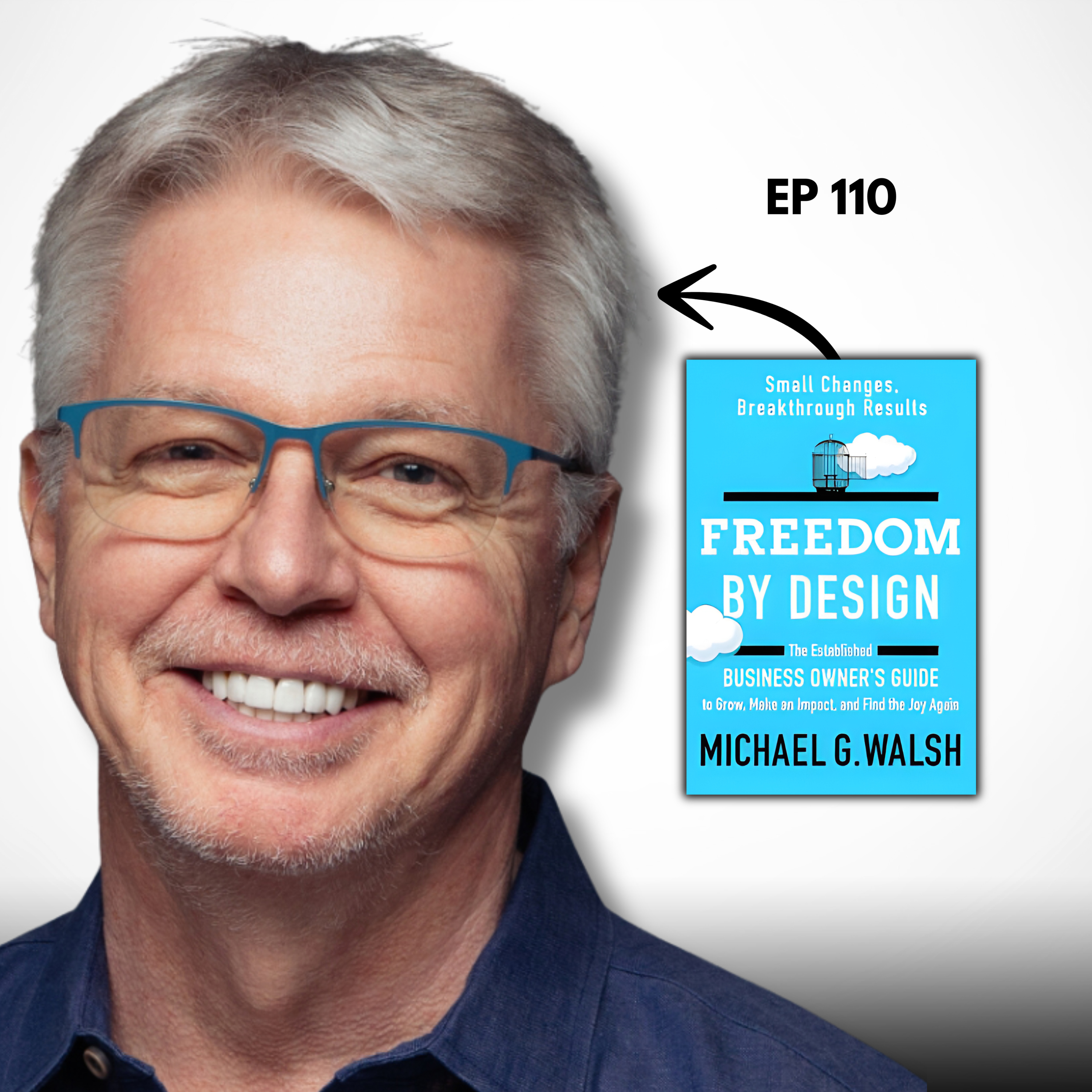






Scaling a service business past the $1M mark is where most leaders hit a wall. In this episode, business growth expert Michael Walsh reveals how to overcome these "pinch points" to design a company that gives you freedom, not just revenue.
We dive deep into the concepts from his book 'Freedom by Design' and explore the "Intelligent Ecosystem" every manager needs to build. If you feel stuck as a busy operator, this conversation is for you.
Follow Michael Walsh
Takeaways
There are many ways to grow a business, tailored to individual strengths.
Identifying pinch points is crucial for overcoming business challenges.
Business growth stages come with unique underlying issues.
An intelligent ecosystem supports both structures and people.
Understanding human behavior is key to effective management.
Listening more leads to better business outcomes.
Time off is essential for sustainable growth and productivity.
Communicating a perceived future requires understanding individual perspectives.
The journey of writing a book can be quick if you have the experience.
Freedom by Design outlines frameworks for navigating business growth challenges.
Sound bites
"You need structures to support the people."
"Time off is a necessary element of growth."
"The more you listen, the better things get."
Chapters
00:00 Introduction to Michael Walsh and His Expertise
02:05 Identifying Pinch Points in Leadership
02:52 Case Study: Louise's Business Transformation
07:07 Understanding Growth Challenges Beyond the First Million
08:55 The Importance of Structures in Business Growth
12:07 The Concept of an Intelligent Ecosystem
13:59 Understanding Human Behavior in Business
19:15 The Role of Perceived Future in Leadership
23:01 Effective Management and Provoking Thought
26:38 Influence and Framing Conversations
28:26 The Power of Framing in Conversations
30:15 The Journey of Writing Books
38:06 Understanding Business Growth Stages
43:42 The Freedom Framework for Business Success
Paul Leon (00:00)
Michael Walsh is a visionary leader, author, and founder of Walsh Business Growth. With over 30 years of experience, he helps service-based owners and senior leaders scale their organizations with clarity, strong systems, and accountability that empowers managers. He is the author of the recent book Freedom by Design.
His books are designed to help leaders break out of what I would call “firefighting mode” and design an organization where people truly perform, grow, and thrive.
I’m excited, Michael, to have you on The Manager’s Mic podcast.
I was studying your LinkedIn profile and I have some questions. The first one is this:
Where are some of those pinch points—let’s call them friction points—where managers in the workplace start moving toward what I think is the ideal state, becoming a strategic leader without losing control of the team and day-to-day operations?
Based on your 30 years of experience, what are some of those friction points? Let’s start there and peel back the onion, if that’s fair.
Michael Walsh (01:08)
What I would say is there are as many ways to grow a business as there are people. We all have different skills, interests, passions, and teams around us. Those factors shape how a business grows.
The problems, however, are very similar.
When you talk about pinch points, I hear impediments. The question becomes: what are the impediments, and how do we help people move past them? If we remove the blockages, things go well.
I worked with a client named Louise. She had been in business for 10 years and was fluctuating between £250,000 and £400,000 in revenue. In 2011, she contacted me after reading my first book and some of my articles.
At that time, she was building an e-learning company. Her bank, Barclays, had cut her line of credit in half following the 2008 recession. She assumed she needed an additional £150,000 to £200,000 to grow.
When I reviewed her numbers, I told her: “You’re a £400,000 company. If you raise £150,000, whoever invests will own your company.”
Instead, we redesigned her pricing, structure, and growth approach. By 2014, she was at £2 million. Over the next four years, she grew to £7.3 million and eventually sold the company to a private equity firm.
What I’ve found is that once owners pass their first million, new structural challenges appear. At £2 million, you hit one set of issues. At £5 million, another. Between £8 and £10 million, a third. Between £12 and £20 million, there’s a major chasm.
You’re too large for the structures that worked at £10 million, and too small to afford the structures needed at £20 million.
The mistake many leaders make is believing business growth is about installing better structures. Structures matter. But structures always change.
If you compare a $1 million company, a $5 million company, and a $10 million company, nearly everything is different—except the owner, core values, and perhaps a few key people.
Leaders often treat a business like a machine. But when people feel like cogs in a machine, they resist.
Instead, we treat the business as an intelligent ecosystem. Structures should serve people—not control them. And leaders need to understand basic human behavior.
Paul Leon (11:39)
You described an “intelligent ecosystem.” A key part of that is understanding human behavior.
When you say that, what does it mean in practical terms? There are countless behavior models out there. For a manager listening to this, what does understanding human behavior actually look like?
Michael Walsh (12:58)
There are thousands of psychology books, and most of them disagree.
You don’t need a psychology degree to lead well. There are four core behavioral elements that explain about 80% of workplace behavior:
Survive – We have a biological need to protect ourselves.
Thrive – We have a desire to grow, contribute, and succeed.
Connect – We need relationships and collaboration.
Adapt – We can adjust to changing environments.
Survive and thrive operate at the same time. If people feel threatened, they shift into survival mode. If they see opportunity, they shift toward thriving.
One key insight: your perceived future shapes your present behavior.
If someone sees a brighter future, they’re energized. If they see a blocked or dim future, they disengage.
When leaders say, “This employee has a bad attitude,” what’s usually happening is that person sees no positive path forward.
Instead of correcting attitude, ask: What future do they see?
Paul Leon (20:02)
If a manager struggles to communicate a compelling future, where should they start?
Michael Walsh (20:38)
The biggest mistake in management is assuming telling equals leading.
Strong individual contributors often become managers. They succeeded by learning and thinking deeply. Then they become managers and assume they should tell others what to do.
Effective management provokes thinking.
Instead of selling a future, discover the future each person wants. Ask questions.
If you tell me a future, I might believe it. If I tell you my future, I will believe it every time.
The person with the most influence is not the person who speaks best. It’s the person who owns the frame of the conversation.
If you set context before delivering a message, people receive it differently.
This idea is well supported in Robert Cialdini’s work on pre-suasion. Setting the frame determines how the message lands.
Paul Leon (27:35)
Let’s talk about your books. You wrote your first book quickly. What inspired that?
Michael Walsh (28:07)
I had been working with clients for over a decade. The material was already structured in my programs. I wrote the first draft in about two weeks while on vacation.
The core insight was this: time off is not a reward—it’s a requirement for growth.
People think they’ll take time off once they succeed. In reality, without renewal, performance declines.
When I began deliberately taking breaks, my income increased. Rest fuels growth.
Paul Leon (35:36)
Tell me about Freedom by Design. Who is it for?
Michael Walsh (35:36)
Freedom by Design is for established service-based business owners who have passed their first million.
It identifies four primary “danger zones”:
Approaching $2 million
Around $5 million
Between $8–10 million
The $12–20 million chasm
The common issues are breaking structures and growing teams.
The book outlines a seven-part Freedom Framework:
Rethink the core (profit, customer value, and professional growth)
Train and grow people
Hire smart
Strengthen teams
Develop managers
Grow leaders
Prepare for unexpected change
The goal is more freedom:
Freedom in the business
Freedom from the business
Freedom because of the business
For your listeners, if they email info@walshbusinessgrowth.com and mention this podcast, we’ll send them a free copy—print, digital, or audio—and cover shipping.
Paul Leon (43:11)
If you could speak to your younger self, before all this growth and experience, what would you say?
Michael Walsh (44:20)
I would say: listen more.
I spent too much time trying to demonstrate what I knew.
The more I listened—to what people said, and why they said it—the better my results became.
There was a period earlier in my career when I assumed my financial background made me knowledgeable about everything. I entered retail, struggled badly, and nearly lost everything. That humbled me.
What I know is not what built my success. What I discovered through dialogue did.
You do not get anything in life until you first give someone else something of value.
That is the foundation of growth.

President of Walsh Business Growth Institute
Michael Walsh is a visionary leader, author, and founder of Walsh Business Growth, with over 30 years of experience helping service-based business owners and senior leaders scale their organizations while creating freedom, clarity, and high-performing teams. He specializes in helping leaders move from being the constant problem-solver to designing organizations that operate efficiently, with strong systems, accountability, and empowered managers. Michael’s insights guide leaders in building workplaces where people thrive, decision-making is clear, and growth is sustainable. Through his work, he helps managers and executives unlock the full potential of their teams while achieving both business results and personal satisfaction.