Plug: Paul Leon here. I want to take my hat off for a moment and speak directly to you, the listener or watcher of our show here at the Managers Mic. Thank you so much for being a consumer of the show, and I want to take our relationship a step further. When you join our newsletter at TheManagersMic.com website, I am going to give you a free resource called a selling script to skyrocket sales.
Paul Leon: I have a returning guest, Curtis, which I am very happy about this episode. I am excited because Curtis and I, just for context, only had minutes going through an assessment that his company sent me. And if I am being frank, Curtis, there are very few that can call me out on my stuff, and I really hold it in high regard. In the assessment, and going through it probably in under 20 minutes, it felt like Curtis knew me for years. And for context, Curtis and I, this is probably only our third conversation, so I am pretty excited to go through some results. He will flash them down the screen. We will not be showing it the whole time, but Eureka Connect solution is cool, and I have had the privilege
Plug: And my promise to you is that resource is totally free, helps you evaluate your current script, and see where it might need some improvement.
Paul Leon: to be a frontline user of it. And we are going to talk through my behavior results because I think one of the key things of being a leader is getting fast feedback loops so you can grow as a professional. Would you not agree with that, Curtis?
Plug: Thank you so much for being a listener and watcher of the show. And now back to the episode.
Curtis Sprouse: Yeah, I think what is nice about this is I always call it behavioral mechanism of action. Why is it that Paul does what he does? And we break it down into—and again, we will share with the guests your profile because you have been so gracious in saying, hey, Kurt, put this all out there. But the things—your discipline, your work ethic—is one of the things that gets you in trouble, because it causes you to be very transactional at times.
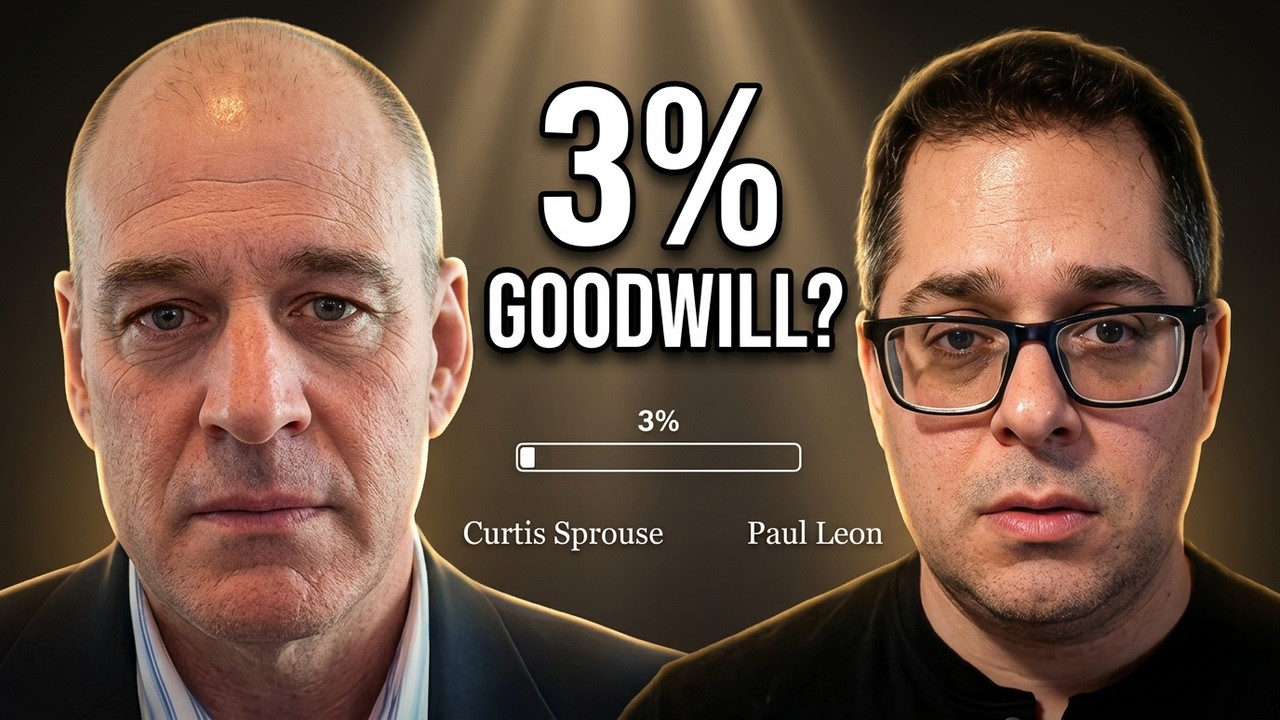
And so having an understanding of the magnitude of that, I mean, I can say that, but when we start to show people the numbers and we see, Jesus, this guy has got a 96 for discipline. There is 4 percent of the world that is more disciplined than he is. His goodwill is a three. Ninety-seven percent of the world has more goodwill. Okay, why is there such a disconnect there?
And it is not because you do not care and you are not a nice guy. It is because you are so driven to deliver that gets in the way of that interpersonal stuff: the social skills, the goodwill that you and I talked about yesterday.
We look at things like your communication score is low. You can be a man of few words. Why? Because your reflectivity—analyze things very quickly. You are impatient, you are moving, you need to get things done. So you can be a man of few words and then you get very frustrated when people do not get—well, why do they not get me? Is it not clear what we need to get done here? No, it is not clear because you did not explain it. It is the curse of knowledge. You have this wonderful picture in your head of the way the world should be, and you get frustrated when the rest of the world does not see it with the clarity with which you see it.
Paul Leon: I am laughing because I have this bad habit, Curtis. A lot of people do not know this—whenever I get, I do not know if uncomfortable is the word, but when it is somebody, it is like, yeah, that is pretty factually accurate, I chuckle. Maybe I feel like it is a defense mechanism. And spot on, just to be very clear. I am not laughing at you or what you are saying because I do not believe it. I am laughing because what is making me uncomfortable is the fact that you are accurate in our dialogue. And I am like, you are calling me out on my shit. And I am like, I got to get better.
And that is why it is important that I get these fast feedback loops. You are right. And that is why I have really enjoyed our conversation yesterday. I wanted to do this podcast with you. You can keep going, just because I think it is important for me to grow and work on these skills.
So in this screen, what you are pulling up is the assessment I took with Eureka Connect. That is what we are looking at right now.
Curtis Sprouse: Right, yeah. So right now what we are doing is we are looking at Paul’s data and what we see here, we are going to focus on the left-hand column.
Energy—he moves at a good pace. And, you know, if we look at his dominance score—and we call these genetics: energy, dominance, reflectivity, authority, discipline, and competing—because they are, how are you hardwired?
My energy score is 99, right? So I walk out fast, talk fast. Everything I do is at the speed of light. That is always good because sometimes I am moving too quickly through life. You have a nice balance. You move in the upper quartile of the energy without being too quick.
Dominance, same thing. You are not ego-driven, Paul. Dominance drives—and it is the trait that drives one’s ego. You and I are comfortable controlling but do not need to control.
Remember I cited a little earlier reflectivity. That is the creative side of the brain versus the pragmatic side of the brain. You think in the abstract, you think in a creative way, your mind processes data quickly.
Authority—why is that 11? Well, you do not like authority. You do not like the autocratic side of it. You do not like that: Paul, I need you to draft up a report for me and do not ask me why, just get it done.
We alluded to discipline, work ethic—and again, there is a perfectionist side of you. There is a side of you that has to get things done, it has to accomplish.
And then competing, you are what is called a strategic competitor.
So when we look at these things, we look at what we call an effective range. And what the effective range constitutes is where consistency occurs. It is not that people cannot be world-class if they are not in the range, it is—
You know, if we look at your authority score, there are times where you are going to have to put structure and process in place and you do not always lead with that. There are times where you are going to have to not overthink something and manage that creative side of your brain. And there are times where Paul is going to have to not worry about perfection, but be realistic about what those around him can achieve.
We talked about this a little bit yesterday. You do not want your children to go through life thinking they have to be perfect.
It is the idea that we strive for perfection to achieve excellence. It is attributed to Vince Lombardi, but it was not actually what he said. The concept is there, which is yes, we want to do great things.
But there was a wonderful thing last night, if you watched any of the Olympics, where the young woman that won the gold medal in skating—she had quit for two years and then she just came back two years ago and said, okay, maybe I will try this again.
And the difference between her and the silver and the bronze medal was she was not mechanical. She was just skating. Like she said, okay, I did all this training, but now it is time for me to perform. And I am not going to think about the performance. I am just going to do the performance.
And for you, it is not overthinking why it is not perfect. It is getting people to say, let’s just get this done. And then we can assess where we can improve later on. And it is a shift in thinking for you. It is not putting the emphasis on the perfection. It is putting the emphasis on: have we prepared? We execute. Then we can go back and assess and improve.
Paul Leon: Okay.
Paul Leon: I thought what was funny about our dialogue yesterday was, just for context—we had a meeting, we did not have enough time, and I started meeting with Curtis. And you can always find the traits of a good professional based on how calm they can be in storming times, because I started the meeting—I feel kind of guilty admitting this—where I go, all right Curtis, I feel like the point of this meeting is this, this, and this, and kind of went down to it.
What I loved about Curtis’s reaction is he did not flinch. He still had the same face, and he was like, who is this guy? Because you did a podcast and you saw the host cowboy hat and I like to have fun. I want to be clear. But when I am in working mode, I think one of the things I am guilty of, like if I am being real with you, is getting me like, all right, here is what we are doing, let’s just do this.
And what you called me out on yesterday was just that—because it is a choice. I wonder if you could speak to what you said to me yesterday, which I thought was really powerful about the fact that what I can do is a choice, but I am just choosing not to do, and how you kind of just called me out on my stuff. I thought that was very powerful because it made me better today in my early morning meetings I had.
Curtis Sprouse: Well, super helpful you bring that up. Let me just bring it up again. I am going to walk the audience through some of this so that sometimes the visuals are very helpful, because it helps people see things.
So if we look now at the profile, what we are looking at is what is called motivational theory. And these are those genetic drivers that I took from that previous screenshot where you saw the raw scores.
And if you look, drive is a function of: how strong is Paul’s drive? Well, he has got great energy. He has got great dominance, balanced dominance. We talked about the excessive discipline and competing. He is what is called a strategic competitor. He will engage with a sense of urgency and a desire to achieve.
One of the things that we talked about yesterday was this concept of interpersonal skills. One of the most important dynamics of a high performer or a great leader is what is called social acuity. It is the intersection between social skills and goodwill.
And if we look, Paul’s score for goodwill—gosh, does he not like people?
Paul Leon: It is a three. It is so bad.
Curtis Sprouse: Yeah, it is three out of a hundred. I mean, you know, what are we doing here?
But there are a faction of people that just do not like other people. Believe me, I find them. I do not believe that is Paul. I mean, the guy would not be doing podcasts if he did not like people, did not like learning about them.
But when you look at his discipline score of 96, he is so driven to achieve and accomplish and—to the point he was making earlier—when I got on the phone with him, on the Zoom call with him yesterday, it was like a different person than the one that had interviewed me for the podcast we did previously. He was so business-like and so serious. And so, well, what is the agenda? We have a half an hour, get to the point, Kurt. And I was like, wow, who is this guy?
But once we got past that 20-minute point in our conversation yesterday, you went back to being the guy that I met on the podcast.
And so what I am looking at here is emotionally, social skills and goodwill. Social skills 44 says, you know how to build a relationship. You just choose who you let into the circle. And part of it is it is an equation for you. Is this person someone that is going to help me achieve?
We talked about—and share this with your guests—you are pretty stressed out. And it is because you are so worried about not achieving, not accomplishing, that this is going by so fast. And if I do not get all this stuff done, how does that reflect on how I conducted myself?
And I do not want anyone to live in that space. I mean, why are you working so hard if you cannot enjoy it?
And what I think really resonated with you yesterday was when I said, is this really what you want for your children? For Noah and Eva, is this really what you want from them? And you stopped. And when you thought about that, you were like, no, that is not what I want.
And I did not share this with you yesterday, but if you are not teaching them how to do it, who is? Who is going to teach them how to balance this stuff and how to find joy in working hard, but also playing hard? Working hard does not mean that you cannot have fun, or that you cannot help others have fun.
And so on the transactional side, communication score is low. You are a man of few words. Get to the point. So you do not always share what is between your two ears. High reflectivity, you think in the abstract, you think quickly. Discipline, you are highly organized with regard to what you want to accomplish, how you want to do it, and you do not always paint that picture in a way that others have clarity as to what you are thinking and why, and hence the lower communication.
Low collaboration is a function of, a lot of times you say, it is just easier for me to do it than to teach Kurt how to do it because he is going to get it wrong anyway. So I will just go do it myself.
``



 Apple Podcasts
 Spotify
 YouTube
 Amazon Music
 RSS Feed
  Goodpods
  iHeartRadio