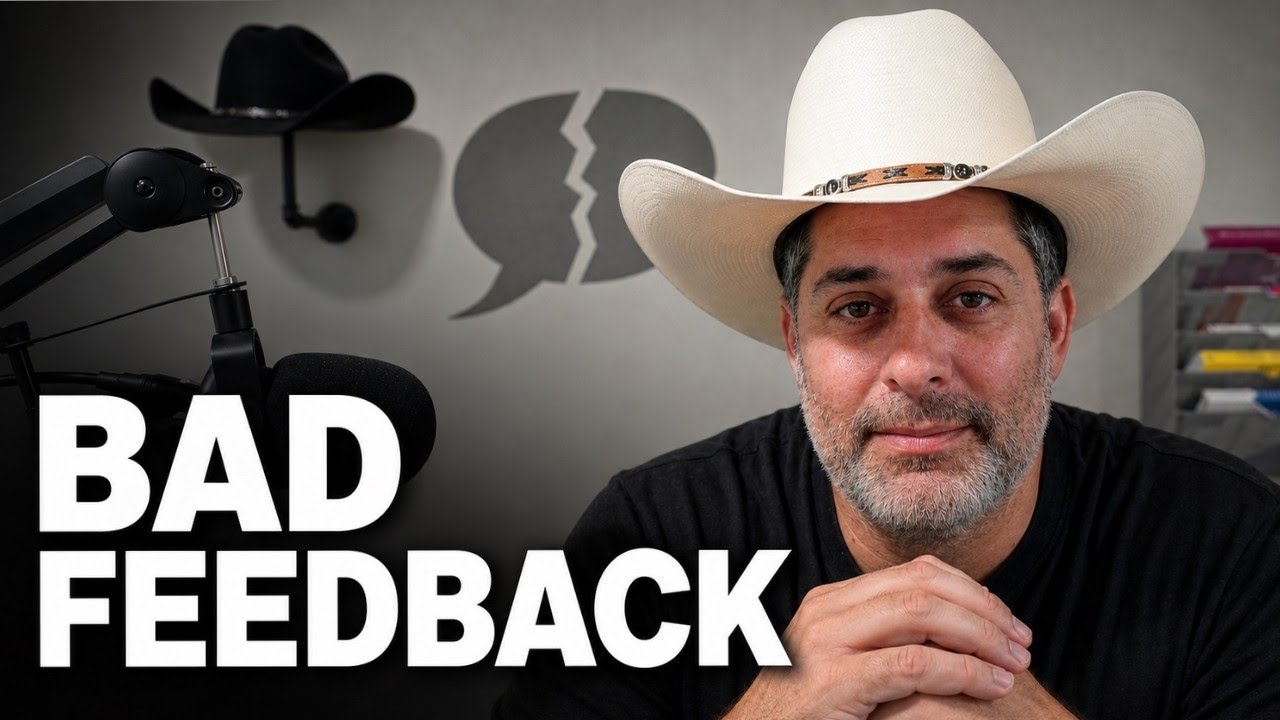
Paul Leon: Today, we are going to explore what I have learned managing 17 direct reports, and we are starting now.
Number one: give enough feedback.
The way you deliver feedback is shaped by your personality, your tendencies, and your blind spots. If you do not know those things about yourself, you will typically project. And projecting your emotions is a surefire way to take rapport and flush it down the toilet.
Think about the last piece of feedback you gave someone on your team. Now ask yourself: was that feedback designed for them, or was it really designed for you? If you cannot say, in your heart, that you were coming from a place of wanting to help that person get better, that is the gap.
That gap is where rapport dies in most communication styles, because it is not about what you want on a personal level. Humans are very good at sniffing out intention. That is something we all share, whether you are a doctor, a lawyer, or working in a station somewhere. It does not matter. We all sniff out intention very, very well.
The good news is: if you do this consistently, your personal brand will grow. Giving effective feedback is an opportunity to grow your brand, not destroy it.
Here is the reframe. Feedback is not a performance conversation. Feedback is an opportunity to build more rapport. I want you to really feel that, because that is what matters.
Most management training will tell you that feedback is to correct behavior, drive results, and hold people accountable. And yes, those things are true in some regard. I am not going to sit here and tell you accountability does not matter.
But here is what nobody told me when I became a manager. Every time I gave feedback, I was either building or destroying the relationship. The key thing I was missing was psychological safety.
When people feel psychologically safe, they trust you more, and they come back to you when something is wrong. One of the biggest compliments is when someone comes to you with something you did not even ask them to bring to you.
Real talk: I used to think directness was always the answer, until I learned this. It is not the words you say. It is the music you play.
Now, if you are a surgeon and someone’s life is on the line, direct is the only answer, in my opinion. Context matters.
In sales or customer service, when someone is mad about a change—like a product update or how a software works—we do need directness. But we need directness with kindness and empathy.
When we do this right, people notice. They say certain key things. These are what I call green flags. People start to say positive things like, “Man, this guy is really self-aware.”
If you challenge yourself to do this consistently for 90 days, you will have more rapport with your teammates by accident.
If you have not done this in a while, take a human behavior assessment like DISC. I am DISC-certified, and I am not trying to sell you anything. Honestly, if you go online and do some of the free profiles, many of them can be just as accurate as the ones you pay for.
Here is another tip: ask for a 360 review from your leader or manager. That does a couple key things. First, you get feedback from people in your closest circle. Second, you will be seen as someone who can take feedback and grow as a leader. And I would encourage you to tell people you did it, because then they will think, “Okay, he is asking for feedback, so I need to model that too.”
I once took an assessment with a company called Eureka Connect. They are not sponsoring this episode. They just came to mind. When they gave me my results, one area said I only had 3% goodwill.
What that means is: people could perceive me as cold and not caring. And that is simply not true. I cry all the time. I go to musicals. I just saw The Outsiders. Great musical, by the way.
But for whatever reason, the test said that is how I was coming across. And impact and intent are two very different things.
So we are going to go through the FAST feedback loop framework. Let us talk about how to give feedback in a way that builds rapport rather than breaks it. I call this the FAST feedback loop: timely, specific, and forward-looking.
Timely means: do not wait for the annual review and stockpile a bunch of feedback. People do not learn that way. That is dumb. I do not know why people do that.
This should be something you do in your one-on-ones. And hopefully you are doing one-on-ones weekly, for a minimum of 30 minutes, so you can show you are paying attention.
Now, be specific. I do not mean saying things like, “Just communicate better.” That is dumb. Anybody can say that. Being specific, even when it is challenging, is more endearing.
Say something like: “Hey, I noticed you interrupted another member of our team. I want to talk to you about that, because my concern is it can make you appear like you are not a good listener. And that is not who you are. I am confident that if we do this differently, you are going to grow your personal brand and your rapport with members of the team.”
See how different that feels? Sure, some people cannot take feedback. But the way I framed it was specific, and it connected the behavior to how they are perceived, while still honoring who they are. It is a better way to give feedback.
Then you always want to be forward-looking. If you take nothing else from this, being forward-looking is so important.
Here is how this works in real dialogue. Say something like: “Here is what I see going forward. What do you want to see going forward?”
Think about any time someone sold you something, or came to your home. They did not just sell you what they can do today. They sold you a future you want to move toward. That is what makes them valuable.
As a manager, you are always selling—technically. You are selling clarity, direction, expectations, and growth.
Here is something else I think you should end every meeting with. Ask: “What do you need from me?”
Every one-on-one, end it with: “Okay, we covered X, Y, and Z. What do you need from me right now to be more successful in your job?” Boom. Then give it back to them.
That is the loop. Be timely. Do this every week. Be specific, not general. Be forward-looking. And end meetings with, “What do you need from me?” so you can help them get the results they want.
That will help you dramatically.
Recap.
First, know yourself. Getting that data is crucial. If you are new, do a DISC assessment after six months, then ask for a 360 review to make it worth your time.
Second, separate intent from impact. I know that sounds counterintuitive because I just told you intention matters. But impact is how it lands.
The hard thing about management they do not train you on is this: people do not see you in those hard conversations, those one-on-ones where someone closes off, or they look down because they start to distrust you—or trust you. Those are the moments where you are truly forged. There is no perfect video or book for that. That comes from experience. Hopefully this saves you from some “ignorance tax” by learning from mine.
Third, use the feedback loop framework I gave you here: timely, specific, forward-looking. And do not only use corrective feedback. Use it for positive feedback too. Catch someone doing something right and name it specifically. That is one of the most powerful rapport builders.
Let me leave you with a personal story to tie this together in a nice bow, and to give you something to reflect on.
I once worked with an engineer—very smart guy. He was an engineer before he was 21. I had the pleasure of working with him when I was in the car rental world.
I will never forget: one day he was unusually quiet. That was strange, because he normally talked all the time.
In the car world, we would deliver cars to customers, sometimes to really wealthy people. I remember one ride that was painfully quiet—like when you have had a fight with your partner and you are in the car and you cannot get out. That kind of discomfort.
We drove there, said nothing, delivered the car, and then got into an Uber to head back. I turned to him and said, “Hey man, listen. You do not have to share anything you do not want to share. I noticed you are really quiet, which is unlike you. You have every right to stay quiet. But if you want me to be a sounding board, just know I am here with you.”
We rode a little farther. What was probably just a few minutes felt like an eternity to me, because I do not do great with silence. That is a flaw I am working on.
Then he turned to me and said, “$17,000.”
I said, “What?”
He said, “$17,000.”
I said, “I do not understand.”
He said, “In my country, the police are often paid off, or they come get you for any reason. I got a call that said there is a warrant out for your arrest. It asked me to put in my Social Security number so I could comply, so the police could come talk to me.”
He said, “Paul, I put my personal info into that robocall because I was so afraid of the police because of the trauma from my country. They took that information and emptied $17,000 from my bank account.”
He told me this intense story, and he said he felt so dumb. He had his family here. He was trying to build a life.
My face got red—not because I was mad at him, but because I was mad that criminals do this. They run robocalls and take advantage of people, especially people who work hard and are trying to build a better life. It made me angry.
A few of us banded together with other teammates and raised money. I was fortunate to know a popular lawyer who had been on TV and helped people through intense situations.
We raised money and went to him. He was a good guy. He said, “Listen, I could take your money, Paul, but I am not going to. Unfortunately, this kid is going to have to learn the hard way. There is no realistic way to track down these criminals. They pop up every second and disappear overnight. That $17,000 is gone.”
I teared up. I started to cry, because I had to tell him.
I told him, “Hey man, I talked to the lawyer. I shared everything. He could have taken the money, but he did not. And he still said there is no way to get it back.”
And he said, “Paul, thank you so much.”
I said, “But I did not get you the result. I did not get you the money back.”
He said, “It does not matter. Thank you for caring. It means everything to me. The fact that you cared that much.”
A few years later, post-COVID, he got his engineering degree in America, bought his mom a house, and took care of his family.
Did he lose $17,000? Yes. But I would argue he gained millions from that lesson, that pain, and what it pushed him to do.
Now, do not misunderstand me. Do not fall for a scam and put your info in. Do not do something that causes yourself harm. The point of the story is to help you avoid it.
But that mistake bonded us together. It made him wealthier, and it made me wealthier—not in money, but in rapport, in trust, in team culture.
And I will tell you this: if you are already recognizing people, praising them, and naming what they are doing right, I personally believe you have already won.
Here is my practical promise. Over the next 90 days, if you apply one insight from this, you will build more rapport with your team by accident.
Thank you so much for watching (or listening). I will see you on the next one.



 Apple Podcasts
 Spotify
 YouTube
 Amazon Music
 RSS Feed
  Goodpods
  iHeartRadio